Protecting the bike
Is bike insurance worth it?
By Ryan - lifelong rider · Updated 2026-08-28
Straight up: I don’t carry bike insurance. Never have. But I get asked about it enough that I went and did the work properly, and read the actual policy forms rather than the marketing pages. Most riders already have more coverage than they think, the real gap is narrower than the industry implies, and there are about four situations where a standalone policy genuinely earns its money. Here’s all of it, including why I’m still not buying one.
One disclosure up front: nobody pays me for this one. Parts of this site run on affiliate links and there’s a page explaining exactly how - but there are none on this page, and no commission behind any name I mention. I looked into whether there could be, decided against it, and I’d rather tell you the useful version.
The 30-second answer
There are three real options and all three are legitimate. Which one fits comes down to what the bike is worth, how you ride it, and what your existing policy already does.
Lean on the policy you have if you own or rent a home, your bike is worth roughly your deductible or less, and you don’t race. You’re already covered for theft, which is what most riders are actually worried about.
Schedule the bike on your existing homeowners or renters policy if it’s worth real money and you want crash damage covered. This is the option almost nobody mentions and it’s the right answer for more riders than either of the other two.
Buy standalone if you race, ride an e-bike, own a bike worth far more than your deductible, or want liability that doesn’t touch your home policy.
What your homeowners insurance already covers
Theft: covered, and better than most people think
Bicycles sit inside the personal property section of a standard homeowners or renters policy, and theft is one of the named perils that section covers. Better still, that coverage follows the bike - it isn’t limited to your address. A bike stolen off a rack at the trailhead or outside a coffee shop is covered on the same basis as one taken out of your garage.
Two corrections worth making here, because the internet gets both wrong:
- There is no universal “$1,500 bike limit.” Bicycles are not on the standard special-limits list that caps jewelry, firearms and silverware. Any bike sub-limit you run into comes from your particular carrier’s form, not an industry rule. Progressive’s consumer guidance uses $1,500 as its example, USAA illustrates with $1,000 or $2,000, and at least one carrier’s actual policy contract names a flat $1,500 bicycle limit - which is exactly why the number to trust is the one on your declarations page.
- The “only 10% away from home” claim is a misreading. That limit applies to property usually kept at another residence - a vacation home, a dorm. (Self-storage units get their own separate 10% cap on newer forms.) A bike temporarily away from home draws on your full personal property limit. Don’t let that one talk you into a policy you don’t need.
Crash damage: usually not covered, and that’s the whole story
Here’s the fact that decides this entire question. A standard homeowners or renters policy covers your belongings on a named-perils basis - roughly sixteen listed causes: fire, theft, windstorm, vandalism, vehicles, falling objects and so on. “I cased a jump and cracked the downtube” is not on that list.
This isn’t a loophole or an exclusion you can argue about. On a named-perils form the loss never triggers coverage in the first place. There is nothing to appeal.
One thing to check before you accept that. Roughly one owner-occupied policy in eight is written on the broader HO-5 form, which covers contents on an open-perils basis, and some carriers sell the same upgrade as an endorsement on an ordinary policy or build it into a high-end product. If that’s your form, a crash is a covered cause of loss and everything below changes. It’s a one-question call to your agent, and it’s the first thing to establish.
One real exception on a named-perils policy: vehicles is a named peril. If a car hits you and destroys the bike, your base policy can respond.
The deductible math nobody runs
This is where the theft coverage you technically have quietly stops being useful.
Flat homeowners deductibles commonly run around $1,000, with $500 to $2,500 the usual band. That’s industry guidance rather than a regulator statistic, and the market has been drifting upward, so the only number that matters is the one on your declarations page. Now run it: your $3,000 trail bike gets stolen, you have a $2,000 deductible, you net $1,000 - and possibly less, because standard contents coverage frequently pays actual cash value, meaning depreciated, unless you’ve specifically added replacement-cost coverage. A four-year-old bike depreciates hard.
Velosurance says the quiet part out loud on its own site: if your bike’s value is near or below your deductible, it’s probably not worth filing a claim at all. Which means for a large number of riders, “my homeowners covers it” is technically true and practically worthless.
The claim you don’t want on your record
This is the strongest honest argument for a standalone policy, and it has nothing to do with coverage breadth.
Filing a homeowners claim can raise your premium and can cost you your claim-free discount. Claims also get reported to an industry database called CLUE, which follows you to other carriers when you shop. The commonly quoted premium bump, somewhere in the 9-20% range, comes from comparison sites and industry groups rather than regulators, so treat it as directional. The retention figure is firmer: state insurance departments in Texas, Washington and Alabama all say CLUE holds up to seven years of claims history.
So the real trade on a $3,000 bike theft claim is this: you collect maybe $500 to $2,000 after the deductible and depreciation, and in exchange you put a multi-year mark on the record that prices the policy covering your entire house. A standalone bike policy claim never touches that record. That, not coverage breadth, is the defensible case for buying one.
One genuinely useful thing I learned, with a catch: Texas bars insurers from surcharging you for a claim they didn’t pay, or for calling to ask questions about your policy. That’s one state’s law, not a national rule. In other states, a loss you report and the insurer never pays can still land on your CLUE report, and Alabama’s insurance department warns that discussing an actual loss with your agent can be treated as reporting a claim even when nothing gets paid. So call - but keep it a coverage question. Say plainly that you’re asking about coverage and not reporting a loss, and don’t describe an incident that already happened until you’ve decided to file. Do that before you do anything else on this page.
The middle option almost nobody mentions
You can add the bike to your existing policy as a scheduled item. Carriers call it different things - State Farm’s Personal Articles Policy, Lemonade’s Extra Coverage, Nationwide’s Valuables Plus, or just a rider, floater or endorsement - but it’s the same move, and for most riders reading this it’s the right one.
What actually changes:
- Named perils become open perils. The trigger becomes “accidental direct physical damage,” which is what finally picks up crash damage.
- The deductible typically drops to zero. State Farm and Lemonade both say so on their own sites. On a $4,000 bike this is the single biggest practical difference.
- Valuation becomes itemized at the scheduled amount - and with some carriers, paid at replacement cost with no deduction for depreciation. State Farm says exactly that. Don’t assume it, though: under the standard ISO scheduled-property endorsement, and on Travelers’ personal articles floater, a bicycle settles at the lowest of actual cash value, repair cost, replacement cost or the scheduled amount. Agreed value is a different form again. Ask which of the three you’re being sold.
- Coverage is worldwide and follows the bike rather than the address.
- Mysterious disappearance is added - the bike that’s simply gone with no explanation at all. Be precise here, because your base policy is broader than riders assume: its theft peril covers “loss of property from a known place when it is likely that the property has been stolen,” so a bike cut off a rack is covered with no proof of forced entry required. The gap scheduling fills is the genuinely unexplained loss.
The cost is the story, though the published numbers are thinner than they look. The only bike-specific figure I could find is roughly 1%, about $100 per $10,000 of coverage, and it comes from a comparison site rather than a carrier. The widely quoted 1-2% band is a jewelry rate. Carriers price scheduled property per $100 of value with the rate varying by location and item type, so nobody publishes a bicycle number. Call it near $60 a year on a $6,000 bike, get a real quote, and note it’s several times cheaper than standalone for comparable property coverage.
What it still doesn’t do: no wear and tear, no mechanical failure, no liability or medical of its own, and it still leaves a claim on your homeowners record.
Two practical notes. First, carriers differ sharply on whether they’ll even schedule a bicycle - State Farm names bicycles, including e-assist bikes, as an explicit insurable class, while Allstate and Nationwide don’t list them at all on their published item lists. Ask your agent directly rather than assuming. Second, you’ll need documentation up front: receipt, make and model, serial number. Take those photos now, not after - and while you have the serial number in hand, register it with Bike Index or Project 529, which is the other half of getting a stolen bike back. Our used buying guide covers that side.
Know what your bike is actually worth
Every one of these decisions starts with a number. Our database lists current prices on 704 builds across 39 brands - that’s your anchor for a scheduled value or a claim. Browse the database →
Four riders who should buy standalone
1. You pin a number plate
If you race, homeowners is a bad bet at any tier - but the sourcing here is thinner than the industry implies. Lemonade’s own comparison chart marks racing coverage as “No” under both its base policy and its Extra Coverage, though Lemonade’s written exclusion is narrower than its chart and bars professional use rather than amateur race day. The standard ISO scheduled-property endorsement contains no racing exclusion at all, and State Farm lists racing bicycles as an insurable class. So don’t assume you’re covered, and don’t assume you’re not. Get it in writing before you pin a plate.
The standalone side has a trap in it. On Markel’s Cyclist form, the paper behind several US bike insurance brands, racing itself isn’t excluded - no disciplines named, nothing carved out for enduro or downhill. It leans the other way, covering the liability you take on by signing a race entry waiver. The one competition-specific exclusion is about parking, not racing: a bike left in a start or transition area more than 24 hours.
Racing gets handled somewhere else entirely - in how you answered the quote form. Velosurance says selecting “competitive” usage is what extends crash coverage to races, and I couldn’t find that restriction anywhere in the published form, which means it lives in an endorsement or in your application answers rather than in wording you can read before you buy. That’s a worse fight than an exclusion: the policy is issued in reliance on the truth of your quote answers, and misrepresenting a material fact voids it. Buy as a recreational rider, crash at an enduro, and you’re not arguing about a clause you could have read. You’re arguing about an answer you gave.
So declare competitive use before race season, and read what you’re actually electing. Sundays makes racing an optional coverage that applies only if it’s printed on your declarations page, and excludes sponsored riders on as little as $2,500 of support in a year - which catches a lot of regional racers on shop deals. BikeInsure puts racing on a separate product tier. And more than one provider heads a feature “racing coverage” that is really entry fee reimbursement: up to $500 back on a race you paid for but can’t start because the bike got wrecked beforehand. That’s a standard Markel-form benefit, not coverage for the crash itself.
2. You ride an e-MTB
This one costs riders real money. Several carriers classify e-bikes as motorized or self-propelled vehicles, which lands them under property not covered on a base policy. USAA tells its own members that homeowners, condo and renters policies typically cover traditional bikes and may not cover an e-bike, and that anything built or modified to exceed 15 mph for use on public roads isn’t covered by its homeowners policy at all - then points you to a separate e-bike policy instead.
Where scheduling is possible, the eligibility rules are narrow and vary by carrier and by state. Lemonade’s test is pedal-assist only with no throttle, motor under 1,000W, and not capable of exceeding 20 mph, which makes most Class 2 bikes ineligible outright and puts Class 3 in a state-by-state gray zone.
Markel - which writes its own e-bike policy, underwrites Velosurance, and is the carrier behind USAA’s e-bike product - uses a different box: 750W, 28 mph, operable pedals. That’s also the box most state e-bike statutes draw, which is why Sundays can simply require your bike comply with state law. Mainstream e-MTBs - Levo, Rise, Kenevo, Rail - are Class 1 and sit comfortably inside it. Three groups get caught: Sur-Ron and Talaria owners who bought from a bike shop and assumed bike insurance applies (explicitly refused), conversion kits (Sundays excludes retrofitted and homemade e-bikes outright), and anyone who derestricted a controller past 28 mph, which turns an eligible bike into an ineligible one.
The part that should actually worry you isn’t the bike, it’s liability - see below. If you’re shopping e-MTBs in the first place, our e-MTB guide covers the buying side.
3. Your bike is worth far more than your deductible
A $9,000 enduro bike against a $1,000 deductible is a completely different calculation than a $1,800 hardtail against a $2,000 one. Once the gap is large, the question stops being “am I covered” and becomes “which vehicle do I want this claim to travel through” - and the answer is usually the one that isn’t attached to your house. Scheduling is the cheaper version of this; standalone is the version that keeps your homeowners record clean.
4. You want liability that isn’t attached to your house
If you hit a hiker, there are three layers. Your homeowners or renters personal liability generally follows you onto the trail - it isn’t limited to your property, and a regular mountain bike isn’t a motor vehicle. That’s the default for most riders and it costs nothing extra. It pays the other person, never you and never your bike.
On an e-MTB, that same motor-vehicle exclusion can knock out that off-premises liability entirely. So the rider on the heaviest, fastest bike, the one most capable of hurting somebody, is the rider most likely to have no liability coverage at all. The fix is an endorsement or a standalone policy with liability on it.
Standalone bicycle liability runs from $25,000 up to somewhere in the $300,000 to $500,000 range - confirm the number on your own quote, because I found the same underwriter’s limit advertised two different ways. On the Markel Cyclist form behind several of these brands, two features beat expectations: a duty to defend, meaning the insurer pays the lawyer, which in a disputed trail collision is often worth more than the payout; and liability written as primary over other collectible insurance, so it sits in front of your homeowners rather than behind it. Check the form behind whichever brand you’re quoting - at least one US bike insurer sells no liability at all.
One exclusion that will surprise people: injuries to members of your own household generally aren’t covered. If you and your spouse or your adult kid crash into each other on a ride, that’s outside the policy.
What none of this covers: you
Every product on this page insures a bicycle. Almost none of them meaningfully insure the rider, and this is the part I think riders get backwards.
Bike-policy medical payments top out somewhere between $1,000 and $10,000. A single helicopter evacuation off a backcountry trail exceeds every medical limit in this market. What actually pays for a broken collarbone is your health insurance, full stop - everything else sits on top of it.
If you want real injury coverage, the product category is accident insurance, not bike insurance. Price depends heavily on which door you come through. Club channels are the cheap one - IMBA members get an on-the-bike plan at about $75 a year for up to $25,000 of medical with a $0 deductible - while USA Cycling now charges $365 a year for its own $0-deductible on-bike coverage. Resort season-pass plans run roughly $85 to $99, and some of them cover no mountain biking at all, so read the activity list before you buy. If you’re doing thirty park days on a high-deductible health plan, the club-channel version is the cheapest risk transfer in this entire guide, and almost nobody buys it.
A warning if you go looking: at least one provider sells two near-identical plans that are mirror images of each other - one covers training, group rides and gran fondos but excludes racing, the other covers only sanctioned events and excludes training and group rides. Same insurer, same headline limit, similar marketing. Buy the wrong one and you’re holding a policy that excludes the exact riding you do.
Five traps worth knowing about
- Lock conditions vary wildly between providers. Sundays requires an approved lock from a hardened-steel list, purchased within two years of the policy start, meeting a minimum retail price that scales with bike value. Your perfectly good five-year-old U-lock is technically non-compliant. Markel’s form just requires a lock with a key or combination. BikeInsure requires no immovable object at all. Switch brands without re-reading the theft conditions and you can void a claim out of habit.
- Your car rack probably counts. On the Markel form, a properly fixed roof or hitch rack meets the “immovable object” definition, and so does a tree. That’s better than most riders assume.
- No US policy requires a Sold Secure or ART rated lock. Those are UK and Dutch standards. If a guide tells you a US policy needs a Sold Secure Diamond lock, that guide is recycling UK content.
- “Uninsured motorist” coverage usually requires physical contact. A driver who buzzes you or runs you off a forest road without touching you triggers the no-contact exclusion - which is exactly the crash riders assume this covers. Hit-and-run notice deadlines are short and unforgiving: police within 24 hours, insurer within 30 days.
- The brand on the policy often isn’t the company carrying the risk. Markel underwrites Velosurance, Spoke and USAA’s bike product, so comparing those can mean comparing identical paper three times. It runs the other way too - two people who both “have Progressive” homeowners can hold policies issued by Progressive Home, Homesite, Openly or Nationwide depending on their state, with different bike terms and different claims handling. The name that matters is on your declarations page, not the website.
And one piece of good news, since riders assume the opposite: I went looking for a bike park or stunt exclusion in a US bike policy form and there isn’t one. Park laps, drops, jumps and shuttle days are ordinary riding. The pattern-matching comes from ski and travel policies, where lift-served mountain biking genuinely is excluded without an adventure add-on - worth remembering before that Whistler trip.
How I’d actually decide
- Call your agent and ask coverage questions. Free, and it answers the only questions that matter: what’s my deductible, is there a bicycle sub-limit on my form, is my personal property covered on named perils or open perils, is my contents coverage replacement cost or actual cash value, and will you schedule a bike. Say up front that you’re asking about coverage and not reporting a loss - outside Texas, describing an incident that already happened can open a claim file even if nothing gets paid.
- Compare the bike’s value to your deductible. If it’s close, your existing coverage is theoretical. That’s the whole test.
- Price a scheduled item first, unless you’re one of the four riders above - then price standalone at roughly 3 to 8 percent of the bike’s value per year, about $100 at the floor and $300 to $400 on a $6,000 trail bike, and declare competitive use up front if there’s any chance you’ll pin a plate.
- Either way, insure your body separately. Health insurance is the real coverage; an accident plan is the cheap add-on nobody buys - about $75 a year if you come through a club, several times that through a governing body.
- Photograph the bike and record the serial number tonight. Every option on this page requires proof of ownership and value, and every one of them is easier before something happens.
Why I rely on my homeowners policy
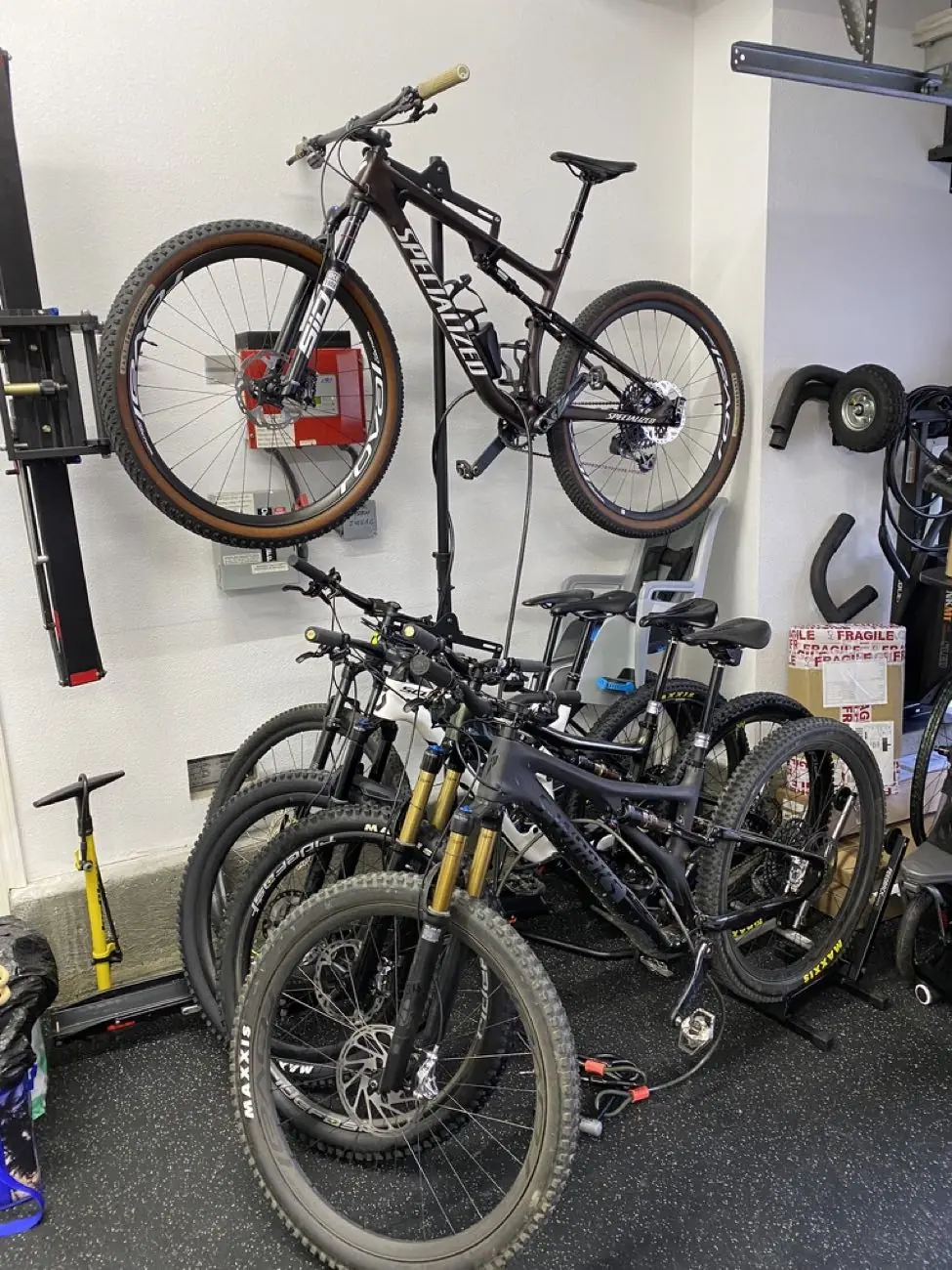
My bikes live in a locked garage, I don’t race enough to worry about it, and I always figured that if one got stolen my homeowners policy would cover it. That last part turns out to be the bit I had right, and it’s most of why I’ve never bought anything extra.
There’s a second reason worth naming, because it applies to a lot of riders and nobody writes about it: I buy and sell bikes constantly. Both paid options attach to a specific bike, by serial number, on a schedule or an application. If your quiver turns over every few months, you’re re-scheduling and re-quoting every few months too, and there’s a gap on either side of every sale where it’s genuinely unclear which bike is on the policy. If you flip bikes, your homeowners policy is the only coverage that doesn’t care what’s in the garage this week.
None of which makes it the right answer for you. It’s the right answer for a locked garage, a rotating quiver, and somebody who doesn’t pin a plate often. Change any one of those and the math moves - and for racers, e-bike riders and anyone with a bike worth well over their deductible, it moves a long way.
The thing I’d most want you to take from all this is that the industry markets the wrong fear. Riders worry about the bike getting stolen, which is the part they’re usually already covered for. The exposures that go uncovered are the quiet ones: crash damage, e-bike liability, and your own body. Whether that sends you to a scheduled item, a standalone policy or a $75 accident plan, all three are good outcomes. The goal isn’t less coverage, it’s coverage aimed at the thing that would actually hurt.
Still choosing the bike itself?
Fourteen questions about how you actually ride, and our AI hands you the five bikes worth your money - with the reasoning behind every pick. Find your bike →
Common questions
Is bike insurance worth it?
It depends on what the bike is worth and how you ride it. If you own a home or rent, theft is usually already covered by your existing policy, and adding the bike as a scheduled item is normally far cheaper than a standalone policy while also picking up crash damage - so that is the first thing to price. A standalone bicycle policy earns its price in four cases: you race, you ride an e-bike, your bike is worth far more than your homeowners deductible, or you want liability coverage that does not sit on your home policy.
Does homeowners insurance cover a stolen mountain bike?
Generally yes. Bicycles fall under personal property coverage, and theft is one of the named perils on a standard policy - including theft away from home, so a bike taken off a trailhead rack is covered the same as one taken from the garage. The catch is not coverage, it is the deductible and how the claim is valued. Some carriers apply their own bicycle sub-limit - Progressive’s consumer guidance uses $1,500 as its example - but it is not an industry standard, so check your declarations page rather than assuming.
Does homeowners insurance cover crash damage to a bike?
Usually not. A standard homeowners or renters policy covers your belongings on a named-perils basis, and crashing is not one of the named perils. There is no clause to argue with - the loss simply never triggers coverage. The exception is a policy that covers contents on an open-perils basis, which is what the HO-5 form and some carrier upgrades do, so confirm your form before you assume you are uncovered. Otherwise, adding the bike as scheduled personal property changes the trigger to accidental direct physical damage, which is what picks up crash damage. One exception on the base policy: vehicles are a named peril, so if a car hits you and destroys the bike, it can respond.
How much does bicycle insurance cost?
Standalone bicycle policies start around $100 a year - that is a common stated minimum annual premium - but the number that actually matters is a percentage of the bike. Specialty policies are commonly priced at 3 to 8 percent of insured value per year, which on the insurers’ own published figures is roughly $150 to $200 on a $3,000 bike, $300 to $400 on a $6,000 bike, and $500 to $700 on a $10,000 one. Scheduling that same $6,000 bike on your existing homeowners or renters policy is usually far cheaper for comparable property coverage. Actual pricing varies by state, bike value and coverage selected.
Does bike insurance cover racing?
Sometimes, and this is where riders get burned. On the Markel Cyclist policy form used by several US brands there is no exclusion for racing itself, but coverage still depends on declaring competitive use when you buy the policy - so it is your quote answers, not the policy wording, that decide it. Other providers make racing an optional coverage you have to elect, or put it on an entirely separate product tier. Homeowners is a bad bet for racing at any tier, though the sourcing is thinner than the industry implies: the standard scheduled-property endorsement carries no racing exclusion, so confirm with your carrier rather than assuming either way.
Are e-bikes covered by homeowners insurance?
Often not. Several carriers classify e-bikes as motorized or self-propelled vehicles, which puts them under property not covered on a base policy. Some will schedule an e-bike, but eligibility rules are narrow and vary by carrier and state - throttle-equipped Class 2 bikes are commonly excluded. The bigger risk is liability: the same motor-vehicle exclusion can knock out your off-premises personal liability, meaning the heaviest, fastest bike is the one most likely to leave you uncovered if you hurt someone.
Not legal or insurance advice. I’m a rider who read a lot of policy forms, not a licensed agent. Coverage terms, prices and eligibility rules change constantly, and they vary by carrier, by policy form and by state - what’s true of one policy may not be true of yours. Read your own declarations page, ask your own agent, and pick the coverage that fits your situation. This is here to help you ask better questions, not to answer them for you.
Get your personal answer in 2 minutes
Guides give you the map. The quiz gives you the pin - your top 5 bikes, AI-matched to how you actually ride, with a plain-English reason for each.
Find your bike →The Quarterly Ride Report
Gear that survived the season
Four emails a year, straight from the trail: no-BS bike & gear reviews from real rides, price-drop alerts on bikes actually worth buying, and first word on new releases worth caring about. No spam, ever - unsubscribe anytime.
Specs and prices are a snapshot compiled from brand-published information - always confirm current details on the brand’s site. Some links earn us a commission at no cost to you; it never affects our picks. No brand pays to be featured.