From my pack to yours
What’s in my pack
By Ryan - lifelong rider · Updated 2026-07-16
Most of my rides are about two hours. I am almost always riding with other people, and on the rides where I am not, I still end up stopping for someone who is out of luck and out of tools. So I carry a bit more than I strictly need. That is a choice, not an accident, and this is exactly what it looks like.
Two systems, not one
The single most useful thing I can tell you about carrying gear is that I do not have one kit. I have two, and they stack.
The bike is always loaded. A Specialized SWAT storage bag lives in the downtube. I never unpack it and I never think about it. Whatever else happens, that stuff is with me.
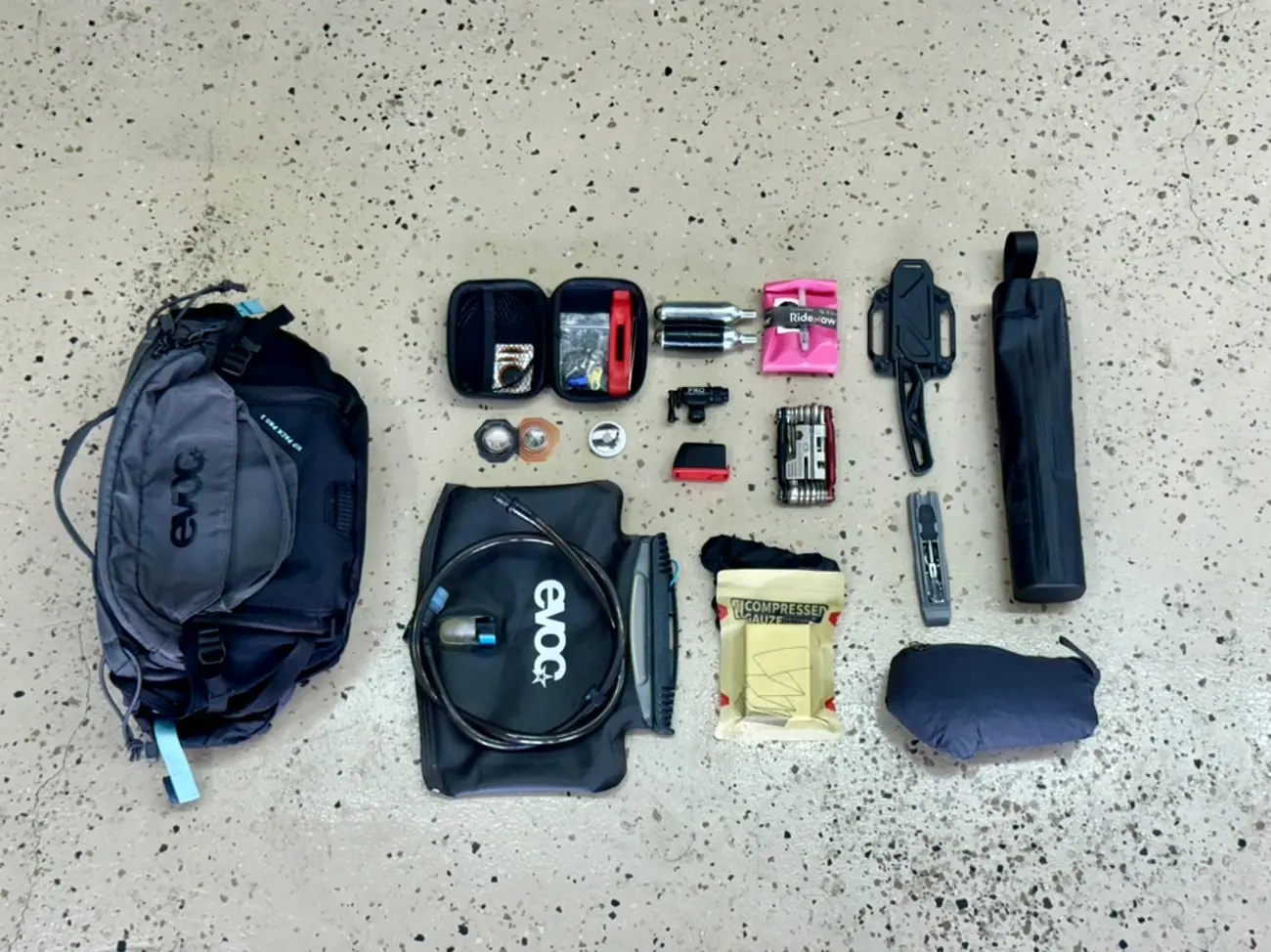
The hip pack layers on top for anything at or past the two-hour mark. Water, the repair pouch, a small medical kit.
The reason this matters: the temptation with one big pack is to skip it on short rides, and then the one time you skip it is the time you need it. Keeping the bike permanently stocked means the floor is never zero. I have never once regretted the weight of a tube in a downtube.

What lives on the bike, permanently
A Specialized SWAT bag in the downtube, packed once and forgotten. If your frame has in-frame storage, this is the single best use of it:
- A lightweight TPU inner tube - these pack down to roughly a third of the size of a butyl tube, which is the entire reason this system works. A traditional tube does not disappear into a frame this easily.
- An Apple AirTag, hidden inside the tube. This is the trick worth stealing from this whole page. It is invisible, it never needs to be moved, and if the bike walks off it is quietly reporting its location. It is not theft prevention. It is theft recovery, which nobody plans for until it is too late.
- A CO2 cartridge - the second one, backing up the one in the pack.
- A tire lever, tire plugs and the plug tool - plugs fix most punctures in under a minute without taking the wheel off. First thing I reach for, every time.
The hip pack: EVOC Hip Pack Pro 3
Waist pack with a hydration bladder rather than a backpack, and that is a deliberate call. Your back stays cooler, nothing pulls on your shoulders on a long descent, and the weight sits at your hips where it does not move you around on the bike. For a two-hour ride there is no reason to carry anything higher up.
The bladder is the part that changes behavior. When drinking means reaching for a hose instead of unclipping a bottle at speed, you drink more, and dehydration on a hot afternoon ruins more rides than mechanicals do.
Inside the repair pouch
One small zippered pouch holds nearly everything, which is the point. If your kit is loose in a pack you will not find it in a hurry, and hurry is the only time you are ever looking.
- Spare bolts - the small hardware that vibrates loose on washboard and disappears into the dirt forever.
- Tire patches - for the tube, when the plug and the sealant are both done arguing.
- Tweezers - not a luxury in Southern California. Cactus spines and thorns come out of tires and out of legs, and fingernails do not do it.
- A tire lever - a second one, because levers snap and levers get dropped.
- A spare SRAM AXS battery - electronic shifting is fantastic right up until the moment it is a single-speed. The battery is a few grams and turns a ride-ending problem into a thirty-second swap on the trail.
- Spare CR2032 coin cells - these run the AXS controllers, the dropper remote and the shifter pod. Different battery from the derailleur, and the one people forget they have until a remote goes dead. They weigh nothing, so carry both.
- A CO2 cartridge and a Pro Bike Tool inflator - the inflator has a proper valve, so you can stop and check pressure instead of dumping the whole cartridge in one go and hoping.
- A master link - pairs with the chain breaker on the multitool. Together they are the difference between riding home and walking home.
- Zip ties - weigh nothing, fix an alarming range of things.
The most useful thing in the pack costs about a dollar
Wrapped around the CO2 cartridge is a few feet of electrical tape. It takes up no space at all, because it is riding on something I am already carrying.
It has held a light back onto a bar. It has held a shifter in place well enough to finish a ride. It does the job whenever something has broken in a way that just needs to be held together for another forty minutes. If you take one idea away from this page, make it this one: wrap tape around a cartridge and forget about it until the day it saves you.
The multitool
A Crankbrothers M20. Twenty tools, which sounds like overkill until you notice it is the hex keys and torx that touch every bolt on a modern bike, plus the chain breaker that makes the master link useful. I have never wished for a bigger one on the trail, and I have definitely regretted carrying one the size of a sandwich.
The mini medical kit
A small ziplock bag, and it earns its space:
- Compressed gauze - takes up almost no room and handles the kind of bleeding that plasters cannot.
- Gloves - because the person you are patching up is usually not you.
- PT tape - doubles as a wound dressing and as the thing that gets a tweaked knee or wrist back to the trailhead.
Mountain bike crashes are abrasion crashes. Build the kit for road rash and for holding a dressing in place, not for paper cuts.
The knife, and the mountain lions
Mounted on the outside of the pack is a Gerber EXO-MOD Caper, a fixed blade. Fixed rather than folding is the whole point: nothing to open one-handed, and the sheath clips straight onto the pack so it is reachable without taking anything off. I ride in Southern California, which is mountain lion country, and I would rather have it and never touch it.
In fairness, it earns its keep in far duller ways: cutting tape, opening packaging, dealing with the fishing line and wire that turns up on trails more often than anyone admits.
And if it ever does come down to a mountain lion, I suppose I fall back on jiu jitsu.
Cold months: the jacket
A packable jacket lives in the outer pocket through the colder half of the year. It weighs almost nothing and it changes a cold, damp descent from genuinely dangerous into merely unpleasant. Mountain weather does not check the forecast before it turns.
The short-ride version
Under about an hour and twenty minutes, I do not take the pack at all. A small multitool goes in the frame bag next to everything that already lives there, a bottle goes on the frame, and that is the whole system.
This is the part people overcomplicate. The bike is already carrying a tube, a plug kit and a CO2, so the short-ride kit is not really a kit. It is just the bike, plus water. Simple and easy is the entire goal.
Why I carry more than I need
Half the things on this page have never fixed one of my bikes. They have fixed other people's.
Ride long enough and you will come across someone at the side of the trail with a flat and no tube, or a snapped chain and no breaker, or a bolt that walked off two miles back. Being the person who can hand over a master link costs you almost nothing and completely changes somebody's afternoon. That is most of the reason my pack looks like this, and it is the part of the sport I would not trade.
The starter shopping list
If you are building from zero, this is the same no-fluff kit I recommend to every new rider - roughly $250-$450 all in:
| Item | Why it’s in the pack | Price | |
|---|---|---|---|
| Trail helmet | Non-negotiable. Modern trail helmets cover more of your head than road lids - get one that fits. | $60-150 | Shop → |
| Flat pedals | Most new bikes ship with throwaway pedals. Grippy composite flats transform your control for cheap. | $40-100 | Shop → |
| Flat-pedal shoes | Sticky-rubber MTB shoes lock onto pedals - running shoes slide off mid-descent. | $80-130 | Shop → |
| Gloves | Grip when sweaty, and your palms hit the ground first every single time. | $20-35 | Shop → |
| Mini pump or CO2 | Flats happen miles from the car. Carry air, always. | $25-50 | Shop → |
| Multitool | Bolts loosen on washboard trails. A pocket hex tool saves the ride. | $20-45 | Shop → |
| Tubeless plug kit | If your bike runs tubeless (most do now), a plug fixes a puncture in 60 seconds. | $15-30 | Shop → |
| Knee pads | The first protection upgrade once jumps enter the picture - knees hit first and heal slowest. | $50-100 | Shop → |
| Full-face or convertible helmet | Park laps and real send deserve chin protection. Convertibles climb open, descend closed. | $150-350 | Shop → |
| Goggles | At park speed, glasses stop working - goggles keep roost and dust out of the equation. | $40-80 | Shop → |
| Second charger | One lives at home, one lives in the car. Dead-battery math ruins more e-MTB days than flats do. | $80-150 | Shop → |
| Torque wrench | Motor mounts and e-bike pivot hardware have torque specs that matter - guessing gets expensive. | $30-70 | Shop → |
Pack sorted - bike next?
Our AI matches how you actually ride to the 5 bikes worth your money, from 39 brands. Find your bike →
Common questions
What should I carry on a mountain bike ride?
At minimum: a way to fix a flat (plugs, a spare tube, a lever and CO2 or a pump), a multitool with a chain breaker, a quick link, and water. Add a small first-aid kit for anything longer or further from the car. Everything past that is comfort, and comfort is fine as long as you know that is what it is.
Do I need a hydration pack or are bottles enough?
Under about an hour, a bottle on the frame is plenty and keeps your back cool. Around the two-hour mark a bladder starts winning, because you drink more when drinking is easy. Heat moves that line a lot closer.
What tools do I actually need on the trail?
A multitool with 4, 5 and 6mm hex keys, T25 torx and a chain breaker covers almost every trailside fix. The two failures that actually end rides are a flat you cannot fix and a broken chain, so carry plugs, a tube and a quick link before you carry anything else.
Why carry electrical tape on a bike ride?
Because it holds broken things onto other things. A light that will not stay in its mount, a shifter clamp that gave up, a torn grip, a rattling cable. Wrap a few feet around a CO2 cartridge and it costs you no space at all.
What spare batteries should I carry for AXS or electronic shifting?
Two different ones, and that catches people out. The derailleur takes the SRAM AXS battery itself; the controllers - the dropper remote and the shifter pod - take CR2032 coin cells. Both are tiny, so carry both. A dead controller battery is exactly as ride-ruining as a dead derailleur battery and far easier to forget about.
Is an AirTag in your bike worth it?
It is a few dollars and it hides inside a spare tube in the frame, so there is no reason not to. It will not stop a theft. What it does is give you and the police an address, which is more than most stolen bikes ever get.
Get your personal answer in 2 minutes
Guides give you the map. The quiz gives you the pin - your top 5 bikes, AI-matched to how you actually ride, with a plain-English reason for each.
Find your bike →The Quarterly Ride Report
Gear that survived the season
Four emails a year, straight from the trail: no-BS bike & gear reviews from real rides, price-drop alerts on bikes actually worth buying, and first word on new releases worth caring about. No spam, ever - unsubscribe anytime.
Specs and prices are a snapshot compiled from brand-published information - always confirm current details on the brand’s site. Some links earn us a commission at no cost to you; it never affects our picks. No brand pays to be featured.